
Concrete Pump Truck Guide: Choosing the Right Rig for Australian Sites in 2026
Updated: Aug 20
Your next concrete pump truck isn't just a capital purchase; it's a ten-year partnership that will either bolster your margins or drain your budget through avoidable downtime. In an industry where a single hydraulic failure can stall a multi-million dollar pour, the difference between a reliable rig and a liability often comes down to the support network standing behind the machine. We understand the daily grind on Australian sites, especially with the 1 July 2026 amendments to the Concrete Pumping Code of Practice now in full effect. It's frustrating when you're navigating complex site access or waiting weeks for genuine spare parts that should be readily available on-shore.
This guide will help you master the technical and operational nuances required to maximise your fleet's efficiency. You'll learn how to select a rig that balances high-pressure performance with the latest National Heavy Vehicle Regulation mass limits. We'll preview the essential maintenance strategies that preserve hydraulic efficiency over long lifecycles and show you how to secure a national support lifeline. Whether you're looking for increased site versatility or a lower total cost of ownership, we've outlined the path to a turnkey solution that keeps your business moving forward.
Table of Contents
What is a Concrete Pump Truck and Why is it Essential for Modern Sites?
A concrete pump truck is a sophisticated, heavy-duty vehicle designed to simplify one of the most physically demanding tasks on a job site: the precise placement of liquid concrete. It integrates a robust carrier truck with a high-performance pumping unit and a multi-section hydraulic boom. This setup allows operators to reach over obstacles, through narrow gaps, and deep into multi-storey structures with surgical accuracy. In the Australian construction sector, the shift from manual pouring and crane-bucket methods to high-volume pumping has transformed project timelines. Whether you're working on a residential slab in the suburbs or a commercial high-rise in the CBD, these rigs are now the standard for efficiency.
The machinery relies on three core components to function effectively:
The Carrier Truck: Provides the mobility and stability needed for site travel and safe setup.
The Pumping Unit: The heart of the machine, utilizing either a piston or squeeze system to move concrete through the pipeline.
The Hydraulic Boom: A manoeuvrable arm that eliminates the need for manual labour at the discharge point, allowing for precise placement.
The primary business benefit is clear: speed. By automating the delivery process, you drastically reduce pour times and on-site labour costs. This efficiency isn't just about finishing a job early; it's about freeing up your crew for the next task and ensuring the concrete is placed before it begins to set, which is crucial in the harsh Australian climate. Investing in a reliable rig means you can take on larger, more complex projects with confidence.
The Evolution of Mobile Concrete Pumping
Modern rigs have seen a significant leap in technology since 2020. Manufacturers have focused on improving fuel efficiency and increasing pumping pressure to handle denser, more sustainable concrete mixes. The integration of advanced remote-control technology allows operators to stand in the safest, most visible position, ensuring every cubic metre is placed exactly where it's needed. A high-quality mobile pump is the backbone of urban infrastructure, providing the reach and reliability required for rapid city growth.
Piston vs. Squeeze Pumps: Which Mechanism Wins?
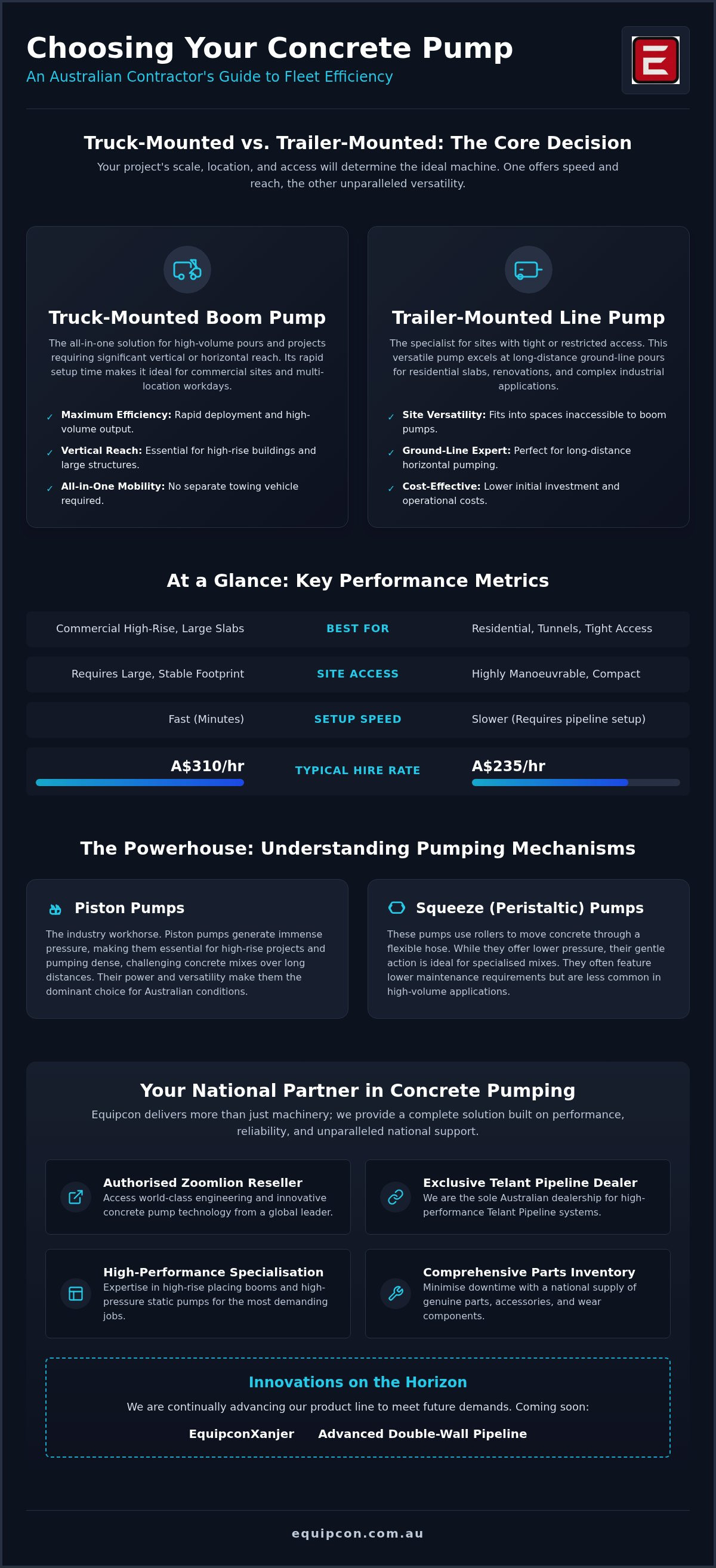
Choosing the right internal mechanism is vital for your long-term operational success. Piston pumps are the industry heavyweights, offering high-pressure performance that is essential for high-rise developments and long-distance ground line pours. If you're pushing concrete twenty storeys up, you'll need the power of a piston system. Squeeze pumps, also known as peristaltic pumps, offer lower maintenance requirements and a gentler handling of specialised or low-slump mixes. Most Australian contractors favour the piston pump because its versatility allows them to take on a wider variety of jobs without worrying about pressure limitations.
Truck-Mounted vs. Trailer-Mounted: The Ultimate Comparison
Deciding between a truck-mounted rig and a trailer unit involves more than just the initial purchase price. Each machine serves a distinct purpose on Australian job sites. A concrete pump truck, often referred to as a boom pump, is designed for high-volume output and vertical reach. It's the go-to for commercial builds where speed is paramount. Conversely, trailer-mounted line pumps are the masters of tight access. They're perfect for residential slabs, backyard renovations, or tunnel work where a massive boom simply won't fit. While the boom pump offers height and convenience, the trailer pump provides a cost-effective solution for long-distance ground lines.
Mobility is where the truck-mounted rig truly shines. These machines offer a significant "set up and pack up" time advantage. An operator can drive onto a site, deploy the outriggers, and be ready to pour in minutes. This all-in-one configuration allows for rapid deployment across multiple sites in a single day, which is a massive boost for your operational flexibility. If you're weighing up the ROI, consider that while a boom pump requires a larger capital investment, it commands higher hire rates. According to 2026 market data, typical boom pump hire rates can reach up to A$310 per hour, compared to A$235 for a line pump. If you're looking to scale your business, you might explore our mobile concrete pumps for sale to see which rig offers the best return for your typical project profile.
When to Choose a Concrete Pump Truck
For multi-storey commercial projects, a concrete pump truck is often the only viable option because vertical reach is non-negotiable. A boom pump can easily navigate site obstacles like fences or power lines that would stop a ground line in its tracks. These rigs are essential for high-volume pours exceeding 100 cubic metres per hour. The efficiency gained from not having to manually drag heavy hoses across a site can't be overstated. It keeps your crew fresh and reduces the risk of on-site injuries.
The Case for Stationary and Trailer Pumps
Trailer pumps remain the first choice for many new contractors due to lower overheads and entry costs. They're incredibly effective for ground-line pumping where the concrete needs to travel hundreds of metres horizontally. In massive infrastructure projects, these stationary units are often paired with separate placing booms to provide a permanent pumping solution for the duration of the build. They offer a level of precision and access that larger trucks sometimes struggle to provide in confined urban environments.
Key Criteria for Selecting Your Concrete Pump Rig
Selecting the ideal concrete pump truck requires a granular look at the specific environments you frequent. If your work mostly involves residential slabs in established suburbs like those in Melbourne or Sydney, a massive 50-metre boom will be more of a hindrance than a help. You need to balance reach with the physical reality of tight suburban streets and overhead power lines. Beyond the boom, the pumping volume and pressure must align with your typical mix designs. A machine that struggles with low-slump concrete will only lead to blockages and frustration on-site.
The fold configuration is a critical specification. A Z-fold boom is designed with a zig-zag opening motion that allows it to unfold in much tighter spaces, making it perfect for indoor pours or sites with low-hanging obstructions. Conversely, a Roll-and-fold system is generally more intuitive for operators and offers a smooth range of motion for open-air projects. Your choice here directly impacts your versatility on diverse job sites. If you often work under low ceilings, the Z-fold is usually the superior investment.
Don't ignore the under-the-hood specs of the carrier truck. The reliability of the chassis is just as vital as the pump itself; if the truck won't start, the pump isn't moving. To ensure your engine remains dependable, you can learn more about Representaciones BURG SpA for critical spare parts for leading brands like Perkins and Caterpillar. Additionally, you must calculate the outrigger spread. On many Australian sites, particularly in medium-density developments, you won't always have the luxury of a wide, flat setup area. Rigs with one-sided support systems or compact outrigger footprints can be the difference between winning a contract and being turned away at the gate.
Analysing Boom Reach for Aussie Projects
For residential foundations and small commercial units, 20m to 30m booms are the industry workhorses. They offer the best balance of weight and manoeuvrability for suburban work. When you move into large-scale industrial floors or bridge works, 36m to 50m+ booms become essential. The trade-off is simple: more reach means a heavier vehicle and a larger site footprint. If you rarely work on infrastructure, the added weight and fuel costs of a 50m rig might not be justifiable for your business model.
Hydraulic Systems and Control Technology
The choice between open-loop and closed-loop hydraulics often comes down to fuel consumption and heat management. Closed-loop systems are generally more efficient for high-pressure work, while open-loop systems can be simpler to maintain. Modern stability control systems are also non-negotiable in 2026. They provide a proactive safety net by monitoring the rig’s centre of gravity in real-time to prevent on-site tip-overs. Look for user-friendly interface systems that reduce operator fatigue, as an exhausted operator is more prone to making costly errors.
Maintaining Your Rig: Reducing Downtime and Sourcing Parts
Owning a concrete pump truck is a significant investment that requires a proactive approach to maintenance. A "dead" pump on-site is more than just a mechanical failure; it's a financial drain that impacts your reputation and your bottom line. When a machine stops mid-pour, you're responsible for the cost of spoiled concrete and the idle time of the entire finishing crew. This is why preventative maintenance is your most effective profit-protection strategy. By identifying small issues before they escalate, you ensure your rig stays on the road and out of the workshop during peak periods.
Should you require machinery relocation or recovery on a Queensland site, discover Done Wright Towing & Transport for professional towing services that keep your operations moving.
Daily inspections are the foundation of a reliable fleet. Before every shift, your operators should check hydraulic hoses for signs of weeping, inspect pipe couplings for secure fitment, and assess the condition of wear plates. These components endure immense pressure and abrasive friction every time the pump cycles. Sourcing genuine spare parts in Australia is essential to avoid the "cheap knock-off" trap. While non-genuine parts might seem like a bargain, they often lack the precise tolerances required for high-pressure hydraulic systems, leading to premature wear and catastrophic failures. To keep your fleet in peak condition, you can order genuine concrete pump spare parts through our national network.
A national service network is a game-changer for contractors who move between regions. Whether you're based in Victoria or taking on a project in Western Australia, having access to specialised depots in VIC, SA, WA, and QLD provides peace of mind. This infrastructure ensures that expert technical support and specialised diagnostic tools are always within reach, regardless of where the job takes you. Consistency in service standards across these locations helps you maintain a predictable maintenance budget and reduces the stress of finding a reliable mechanic in a new territory.
Critical Wear Parts to Keep in Stock
Maintaining a small inventory of critical wear parts can save you days of downtime. The wear plates and cutting rings are the heart of the S-valve system; if these are worn, your pumping efficiency will drop significantly. You should also keep a supply of pipe gaskets and couplings to prevent messy blow-outs that can halt a pour instantly. Finally, keep an eye on your piston rams. If you notice the pump losing prime or struggling with thicker mixes, it’s often a sign that the rams need replacement before they fail completely.
Professional Repair vs. DIY Maintenance
While daily greasing and basic inspections can be handled by your crew, certain tasks require a specialist's touch. Hydraulic pump overhauls and annual boom structural inspections are non-negotiable for safety and compliance. Professional diagnostic services can identify hidden issues in the hydraulic circuit that a visual check might miss, such as internal pressure drops or heat spikes. Establishing a long-term relationship with a national supplier ensures consistent service standards and provides a comprehensive history of your machine's health.
Why Equipcon is Your National Partner in Concrete Pumping
Choosing your next concrete pump truck is a decision that defines your operational capacity for the next decade. At Equipcon, we don't just sell machinery; we provide a comprehensive support ecosystem designed to keep your fleet operational and profitable. Our range includes high-performance mobile concrete pumps, stationary units, and placing booms tailored for the diverse requirements of Australian infrastructure. Whether you are scaling up for large-scale commercial builds or need a compact rig for residential slabs, we offer the technical expertise to match the right machine to your project pipeline.
The "Equipcon Advantage" is rooted in our proactive approach to after-sales care and long-term reliability. We maintain a massive inventory of high-quality pipeline accessories and genuine spare parts for a wide range of leading equipment manufacturers. This readiness ensures that when you need a critical component, we can dispatch it rapidly to minimise your downtime. Our goal is to reduce client stress by ensuring that every machine we supply is backed by a reliable national lifeline and the parts required to keep it on the road.
Our commitment to your success extends beyond the initial sale. We understand that a concrete pump truck represents a significant capital investment, which is why we focus on the entire equipment lifecycle. From specialised repair services for hydraulic systems to the provision of turnkey accessories, we position ourselves as the attentive partner you can rely on when the pressure is on. We take pride in our "boots-on-the-ground" friendliness, ensuring that every contractor feels supported by an industry leader who understands the daily grind of the site.
National Reach, Local Expertise
Our service network spans across VIC, SA, WA, and QLD, providing you with local support regardless of where your project is located. From a remote site in Western Australia to a busy CBD project in Melbourne, our team offers transparent communication and technical authority. We utilise advanced hydraulic diagnostic tools at our service depots to identify and resolve issues with precision across a wide range of pump truck models. This national reach means your fleet is never truly alone, and expert help is always within a reasonable distance for rapid dispatch.
Secure Your Next Rig Today
Investing in a new rig involves more than just a transaction; it requires a strategy for long-term productivity. Our specialists consult with you to provide turnkey solutions that include comprehensive training, structured maintenance schedules, and ongoing parts support. We take the guesswork out of fleet management, allowing you to focus on the next pour with total confidence. If you're ready to upgrade your capabilities and lower your total cost of ownership, you can view our current range of concrete pumps for sale and speak with a partner who is as invested in your success as you are.
Future-Proof Your Fleet for the Next Decade of Infrastructure
Navigating the complexities of site access and evolving regulations requires more than just a powerful machine; it requires a strategic approach to your fleet. By matching your concrete pump truck to your specific project pipeline and committing to a rigorous maintenance schedule, you can significantly reduce the total cost of ownership while boosting productivity. Success in 2026 depends on having a reliable partner who understands the technical demands of hydraulic efficiency and the logistical reality of Australian construction sites.
Equipcon provides that stability through our national network of service depots in VIC, SA, WA, and QLD. As Australia's leading source for Zoomlion parts and machinery, our specialised hydraulic repair experts are dedicated to keeping your rigs ready for the next pour. We support your business through every lifecycle stage, from the initial inquiry to long-term maintenance and genuine spare parts supply. It's about building a relationship that lasts as long as the machinery itself.
Explore our high-performance concrete pump trucks and national support network to secure a rig that delivers consistent results. We look forward to helping you grow your business with confidence and precision.
Frequently Asked Questions
What is the average lifespan of a concrete pump truck in Australia?
A well-maintained concrete pump truck typically has an operational lifespan of 10 to 15 years in the Australian market. This longevity depends heavily on the volume of concrete pumped and the rigour of your preventative maintenance schedule. Because of our high-UV environment and often abrasive local aggregates, rubber components and hydraulic seals may require more frequent replacement to ensure the machine reaches its full service potential.
How often should I replace the wear plates and rings on my pump?
You should generally inspect your wear plates and cutting rings every 2,000 to 5,000 cubic metres of concrete delivered. The exact timing depends on the abrasiveness of the mixes you typically pump. If you notice a visible gap between the plate and the ring or a loss of pumping pressure, it is time for a replacement to prevent concrete from leaking back into the hopper and damaging the S-valve.
Can I use a boom pump for high-rise construction, or do I need a stationary pump?
Boom pumps are excellent for medium-rise projects, but true high-rise construction usually requires a stationary pump paired with a placing boom. Once a project exceeds the vertical reach of a standard truck, which is typically around 60 metres, a stationary unit becomes essential. These units provide the sustained high pressure needed to pump concrete vertically over dozens of storeys while maintaining a much smaller footprint on congested CBD sites.
What are the licensing requirements for operating a concrete pump truck?
Operating a concrete pump truck in Australia requires a Heavy Rigid (HR) or Heavy Combination (HC) truck licence, alongside a High Risk Work Licence for concrete placing booms (Class PB). Operators must also stay compliant with state-specific safety regulations. It is vital to note that the amended Concrete Pumping Code of Practice took effect on 1 July 2026, introducing updated safety and documentation requirements that all fleet owners must now follow.
Do you supply spare parts for brands other than Zoomlion, such as Schwing or Putzmeister?
Yes, we maintain an extensive inventory of high-quality spare parts and pipeline accessories for major brands including Putzmeister, Schwing, and Zoomlion. Our national network of depots ensures that you can source gaskets, couplings, and wear parts quickly, regardless of your rig's manufacturer. We focus on providing genuine and premium aftermarket components that meet the high-pressure demands of the Australian pumping industry.
What is the difference between an open-loop and a closed-loop hydraulic system?
The primary difference is how the hydraulic fluid circulates; an open-loop system draws fluid from a reservoir and returns it there, while a closed-loop system moves fluid directly between the pump and the motor. Closed-loop systems are generally more efficient for the high-pressure demands of a concrete pump truck and offer smoother control. Open-loop systems are often favoured for their simplicity and ease of cooling in hot Australian conditions.
How do I choose between a Z-fold and a Roll-and-fold boom configuration?
Choose a Z-fold configuration if you frequently work on sites with low ceiling heights or significant overhead obstructions, as it can unfold in very tight vertical spaces. Roll-and-fold booms are often preferred for open-air residential and commercial sites where ease of operation is the priority. The Roll-and-fold design is intuitive for newer operators and excels at reaching over fences or second-storey balconies with a smooth, predictable motion.
What should I look for in a pre-purchase inspection for a used concrete pump?
Focus your inspection on the structural integrity of the boom and the health of the hydraulic circuit. Look for any non-certified welds, stress cracks, or signs of hydraulic oil contamination. It is also essential to review the service history to confirm that major overhauls were performed by specialists. Ensure the wear components have plenty of life left, as replacing a full set of pipes and wear plates immediately after purchase can be a significant hidden cost.


Comments