
Mastering High-Rise Efficiency: The Essential Guide to Concrete Placing Booms for Sale in 2026
Updated: Aug 20
What if your next high-rise project didn't just meet its deadline but actually beat it by weeks, all while your labour costs stayed firmly under control? Most site managers across Australia know the daily headache of manual concrete distribution and the constant frustration of waiting for a crane that's already stretched too thin. When you're researching concrete placing booms for sale, you aren't just buying steel and hydraulics; you're investing in a faster, leaner construction cycle. It's about turning a logistical bottleneck into a competitive advantage that pays for itself through sheer productivity.
We understand that site congestion and machinery downtime are the enemies of a profitable build. That's why this guide focuses on helping you select and integrate the right concrete placing boom to slash manual labour expenses and accelerate your project timelines. We'll explore the latest 2026 technology, including self-climbing systems and the impact of updated safety standards like the ANSI/ASSP A10 revisions. You'll also learn why local technical support and a reliable parts network are the real keys to keeping your floor cycles on track without the stress of unexpected delays.
Table of Contents
Understanding Concrete Placing Booms: A Game-Changer for Modern Sites
Hydraulic vs. Manual Placing Booms: Selection Criteria for 2026
Maximising ROI: Why Investing in a Placing Boom Trumps Mobile-Only Setups
Essential Checklist for Evaluating Concrete Placing Booms for Sale
The Equipcon Advantage: Sourcing and Supporting Your Next Placing Boom
Understanding Concrete Placing Booms: A Game-Changer for Modern Sites
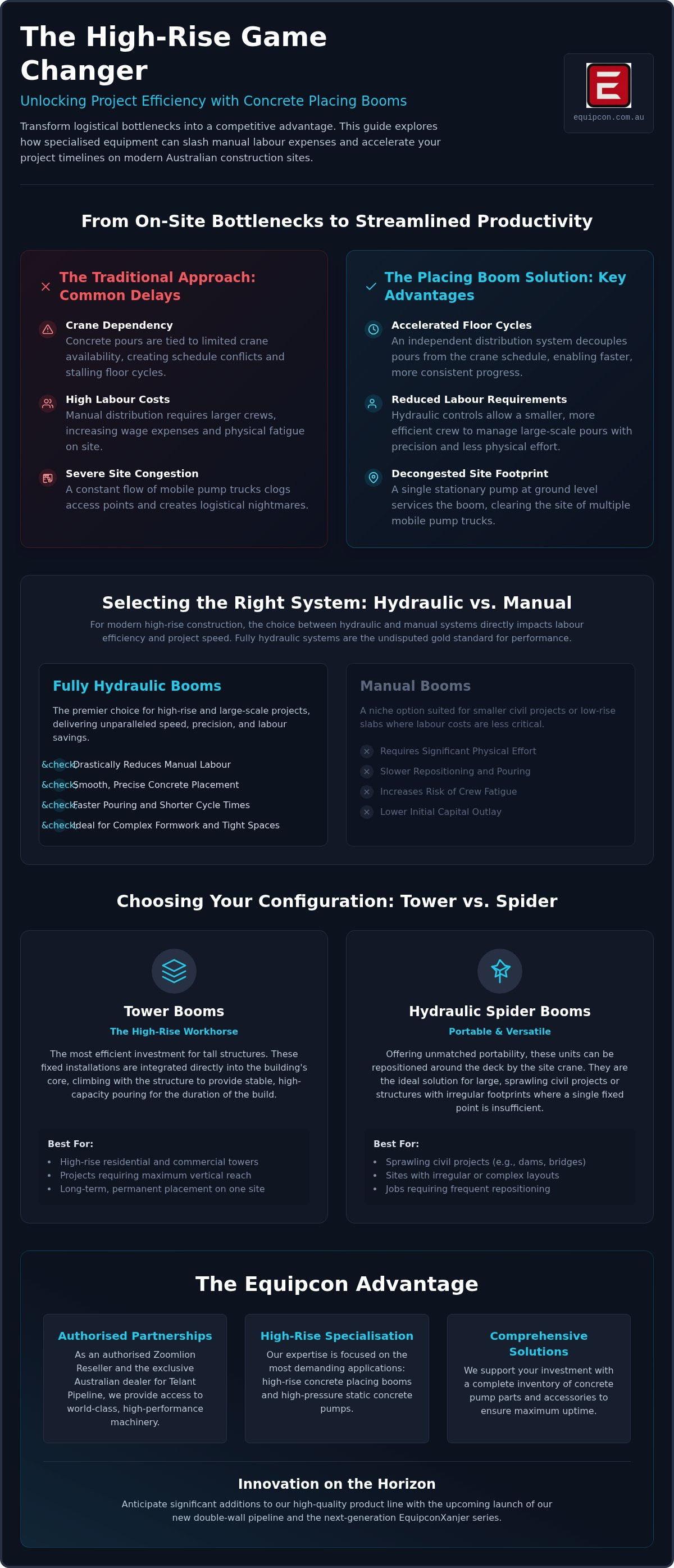
High-rise construction in Australian cities like Melbourne, Sydney, and Brisbane is evolving at a rapid pace. Relying solely on mobile boom pumps for every pour becomes a logistical nightmare as buildings climb higher and sites become more cramped. If you are currently researching concrete placing booms for sale, you are likely looking for a way to solve the problem of site congestion while maintaining a strict pour schedule. Unlike a standard truck-mounted pump, a stationary placing boom acts as an independent distribution system. It remains anchored to the structure, allowing your crew to deliver concrete exactly where it's needed without the need to coordinate a massive vehicle movement every time a new slab is ready.
The core difference between these systems and traditional setups lies in their versatility and reach. While Wikipedia's overview of concrete pumps explains the broad mechanics of moving wet mix, a placing boom specialises in vertical efficiency and precision. By decoupling the actual pump from the distribution point, you create a far more streamlined workflow. The stationary pump remains at ground level, easily accessible by agitator trucks, while the boom sits high up on the deck, climbing alongside the building's core. This setup effectively eliminates the mobile-only bottleneck that often stalls progress on high-density projects.
The Anatomy of a Placing Boom
A typical unit consists of a sturdy pedestal, a vertical mast, and a series of articulating boom arms. The hydraulic system provides the necessary muscle, allowing for smooth and precise movements even when the boom is fully extended under pressure. These machines are engineered for endurance and accuracy; the articulating boom arms typically offer a full 360 degree rotation to ensure every corner of the slab is within reach. This level of flexibility is what allows a smaller crew to manage large-scale pours with significantly less physical strain compared to traditional line pumping.
Tower Booms vs. Spider Booms
Choosing the right configuration depends entirely on your site layout and the specific demands of your project. Fixed tower installations are the undisputed workhorses of the high-rise world. They are often integrated into the building's lift core or bolted to the structure using specialised floor frames. If your project requires maximum height and a permanent placement for the duration of the build, a tower boom is usually the most efficient investment. It provides a stable, high-capacity solution that moves up the building as each floor is completed.
In contrast, hydraulic spider booms offer a level of portability that fixed towers simply cannot match. These units can be moved around the deck using the site crane, which makes them ideal for sprawling civil projects or sites with irregular footprints where a single fixed point won't cover the entire area. While they occupy a smaller footprint than tower systems, they still provide the same hydraulic precision. When you are looking at concrete placing booms for sale, consider whether your priority is a permanent, high-reaching fixture or a versatile tool that can be repositioned to suit a changing work zone.
Hydraulic vs. Manual Placing Booms: Selection Criteria for 2026
Selecting the right equipment for a high-rise build often comes down to the balance between initial capital outlay and long-term labour savings. In the current market, the shift towards fully hydraulic systems is undeniable. While you might still see manual booms on smaller civil projects or low-rise residential slabs, they are becoming a niche choice. Manual units require significant physical effort to position, which inevitably slows down the pour and increases the risk of site fatigue. When you're browsing concrete placing booms for sale in 2026, the labour-saving potential of a hydraulic system usually outweighs the lower entry price of a manual alternative.
Modern articulating Z-fold booms have also changed the game for tight urban sites. These designs allow the boom to unfold in areas with low overhead clearance, providing a level of manoeuvrability that older models simply can't match. This flexibility ensures your crew can reach every corner of the formwork without constant repositioning. Adhering to OSHA safety standards for concrete pumps is a non-negotiable part of modern site management, ensuring that these high-pressure systems operate within safe limits while maximising output.
Performance Metrics That Matter
Reach is the first metric most project managers look at, and for good reason. A boom with a 28-metre or 32-metre reach can often cover an entire floor plate from a single central position. However, you must also consider pipeline diameter and pressure ratings. High-pressure ratings are essential for high-rise pumping to overcome the friction of vertical delivery. If you're unsure which configuration fits your next project, checking out the range of stationary concrete pumps and booms can help clarify your requirements and ensure your setup handles the specific concrete mix you intend to use.
Ease of Climbing and Re-positioning
The way a boom moves up the building is just as important as how it pours. Floor-climbing mechanisms are popular for their stability, while shaft-climbing systems are often preferred when floor space is at a premium. Quick-connect systems are now a standard expectation; they allow for rapid transitions between floors, which minimises downtime. When evaluating concrete placing booms for sale, look for units that offer modular climbing frames to suit different structural designs. You must also account for the total weight of the unit. A boom that is too heavy for your site crane to lift will lead to expensive engineering workarounds, so finding the sweet spot between reach and weight is the key to a smooth, efficient build.
Maximising ROI: Why Investing in a Placing Boom Trumps Mobile-Only Setups
Investing in a dedicated distribution system is about more than just moving wet mix; it's a strategic move to reclaim your site's efficiency and bottom line. While many contractors start with mobile pumps, the limitations become clear once a project scales vertically. By opting for concrete placing booms for sale, you effectively remove the need for a fleet of mobile pump trucks to be permanently stationed on-site. This shift doesn't just lower your daily hire costs; it significantly reduces site traffic and logistical congestion, which is a massive win for projects in cramped urban centres where every square metre of space is at a premium.
Accelerating your floor cycles is the fastest way to improve project ROI. A permanent distribution point means your team isn't waiting for a pump to arrive, park, and unfold. Instead, the infrastructure is already there, climbing with the building and ready to pour the moment the agitators are on-site. In the Australian market, high-quality placing booms also hold their value remarkably well. The resale market for well-maintained machinery remains strong, ensuring that your initial investment is backed by a tangible asset with a clear exit strategy once the project is complete.
The long-term value of any high-rise or commercial project is further enhanced by the quality of its external finishes; to discover premium decking and cladding options, check out Paveezzi Composites.
Reducing Labour and Material Waste
Efficiency also comes down to what you don't use. Long mobile pump lines often result in a significant amount of "dead concrete" that must be cleared at the end of every pour, leading to unnecessary material waste. A stationary boom setup minimises this waste by using a more direct and permanent pipeline route. Precise placement also means your crew spends less time on manual screeding and shovelling, as the boom can deliver the mix exactly where it's needed. For those still weighing up their options, our guide on Mobile Concrete Pumps for Sale: The Ultimate Guide for Australian Contractors provides a detailed comparison to help you decide which setup fits your business model best.
Operational Continuity and Reliability
Relying on external hire pumps introduces a level of risk that can derail a tight schedule. Owning your distribution system gives you total control over operational continuity, allowing for 24/7 readiness on major builds. Unlike mobile units that require a fresh start every day, stationary booms eliminate the hours spent each morning on setup time because the pipeline is already in place and the boom is ready to operate as soon as the first agitator arrives. This reliability is reinforced when you partner with a specialist who understands the entire lifecycle of the machinery, from the initial purchase to long-term maintenance and spare parts support.
Essential Checklist for Evaluating Concrete Placing Booms for Sale
Purchasing a distribution system is a significant capital commitment, so you need a rigorous verification process to ensure the machinery is fit for purpose. When you're assessing concrete placing booms for sale, start with the heart of the machine: the hydraulic system. You must verify that the pump capacity meets your project's volume requirements and that the oil cooling systems are robust enough to handle the Australian summer. Overheating is a common cause of downtime, so a proactive check on the heat exchanger and hydraulic fluid quality is essential before any money changes hands.
The structural integrity of the mast sections and slewing gear is equally critical. Look for signs of fatigue, uneven wear, or past repairs that might indicate the boom has been pushed beyond its limits. If you're looking at used or refurbished units, a comprehensive review of the maintenance history is non-negotiable. You want to see evidence of regular servicing and the use of genuine wear parts. Pipeline thickness is another often-overlooked detail; a thin pipe won't just wear out faster, it can also lead to dangerous blowouts under high pressure. Ensure the remote control system is industrial-grade and provides the responsive feedback your operator needs for precision pours.
Australian Standards and Compliance
Compliance isn't just about safety; it's about your ability to actually get the machine onto a tier-one site. Every unit must meet AS 2550.15 for safe operation. You should demand site-ready documentation and up-to-date logbooks that prove the machine has been maintained according to Australian requirements. A key part of this is the 6-year major inspection. This is a deep-dive structural report that identifies any hidden issues in the boom's metallurgy or hydraulic components. Without a current major inspection certificate, your new asset could be grounded before the first pour even begins.
Brand Reputation and Parts Availability
Choosing an established brand like Zoomlion provides a level of security that "orphan" machinery simply cannot match. Zoomlion was ranked in the top 5 global construction equipment manufacturers in 2021, and that scale translates to better engineering and long-term support. The danger of buying a generic boom is the lack of a local spare parts supply. If a specialised seal or hydraulic valve fails, you don't want to be waiting weeks for an international shipment. Before you commit, evaluate the local technical repair network. If you want to ensure your investment is backed by national support and expert technicians, explore our range of high-performance placing booms to see how we manage the entire equipment lifecycle.
The Equipcon Advantage: Sourcing and Supporting Your Next Placing Boom
Finding the right machinery is only half the battle; the real value lies in the support that keeps that machinery turning on-site. At Equipcon, we don't just list concrete placing booms for sale and walk away once the invoice is settled. We're committed to "turnkey" readiness. This means every unit we supply is fully compliant, thoroughly tested, and ready to be integrated into your project's workflow immediately. Whether you're managing a massive tower build in Melbourne or a complex civil project in Perth, our goal is to reduce your stress by providing equipment that arrives ready to work from day one.
Our partnership with Zoomlion ensures your site is equipped with industry-leading technology. As a brand that consistently ranks in the top five global construction equipment manufacturers, Zoomlion delivers the performance and hydraulic precision required for the most demanding Australian builds. We complement this high-performance machinery with our own range of high-quality pipeline and accessories. By controlling the quality of every component from the pump to the boom tip, we help you maintain consistent flow and minimise the risk of blockages or premature wear.
Beyond technical components, maintaining a professional team identity on-site is essential for large-scale operations; many Australian contractors rely on Custom Patches Australia for durable, high-quality branding on their workwear and safety gear.
Comprehensive After-Sales Care
The relationship we build with our clients is our primary product. We understand that every hour of downtime on a high-rise site can cost thousands in lost productivity. To combat this, we've established a national network of specialised service depots across Victoria, South Australia, Western Australia, and Queensland. If a technical issue arises, our industry-literate specialists are ready to provide expert diagnostic services and hydraulic repairs to get you back on track. We maintain a proactive spare parts inventory, specifically focused on Zoomlion components, to ensure you aren't left waiting for international shipments while your project stalls.
Ready to Elevate Your Project?
Every site has its own unique set of challenges, from tight footprints to complex structural requirements. We don't believe in a one-size-fits-all approach. Our team is here to provide a supportive guide through the entire lifecycle of your equipment, starting with a tailored quote based on your specific site requirements. If you're unsure which configuration will deliver the best ROI for your next build, we can organise a technical consultation or a site assessment to help you make an informed decision. Our "boots-on-the-ground" friendliness and professional authority ensure you get the right tool for the job every time. View our current range of concrete placing booms for sale and discover how we can help you accelerate your next project with confidence.
Future-Proof Your Site Productivity
Mastering vertical construction in 2026 requires more than just heavy lifting; it demands a strategic approach to distribution that keeps your site clear and your crew productive. By moving beyond mobile-only setups and investing in the right concrete placing booms for sale, you effectively decouple your pour schedule from site congestion. This shift ensures faster floor cycles and significant long-term savings on labour and hire costs. Success on a tier-one site hinges on compliance and reliability, so always prioritise machinery that meets Australian standards and is backed by a robust technical support network.
Equipcon is here to act as your supportive guide throughout the entire equipment lifecycle. With our national network of service depots in VIC, SA, WA, and QLD, plus our specialised Zoomlion parts and repair expertise, we ensure your machinery stays site-ready and operational. Whether you need Australia-wide logistics or local technical support, our team is ready to help you streamline your next project.
Contact Equipcon today for expert advice on concrete placing booms and let's get your build moving with total confidence.
Frequently Asked Questions
What is the difference between a boom pump and a concrete placing boom?
A boom pump is a truck-mounted vehicle that combines both the pump and the boom; a concrete placing boom is a separate distribution unit that is often anchored to the building's core. While the truck-mounted version is mobile and self-contained, the placing boom is designed for vertical projects where the distribution point needs to move independently of the pump. This allows the stationary pump to stay at ground level for easy agitator access while the boom reaches the higher decks.
What is the maximum reach of a typical high-rise placing boom?
Most standard high-rise placing booms offer a reach between 28 and 33 metres, though some specialised models can extend up to 36 metres or more. Choosing the right reach depends on your slab size and site layout. If the boom is centrally located, a 32-metre reach is often enough to cover an entire floor plate without needing to reposition the machinery or use manual line pumping to reach the corners.
How much space is required to set up a hydraulic spider boom on-site?
Hydraulic spider booms are prized for their compact footprint, typically requiring a setup area of approximately 4x4 or 5x5 metres. The exact space depends on the outrigger configuration and the specific model you choose for your project. Because they don't require a permanent tower or lift-core mounting, they are an excellent solution for sites where space is limited but you still need the precision and labour savings of a hydraulic arm.
Are placing booms for sale compliant with Australian safety standards?
All concrete placing booms for sale through authorised Australian dealers must comply with AS 2550.15 to ensure safe operation on-site. This standard covers the design, inspection, and maintenance requirements necessary to meet local safety regulations. When you buy from a specialist like Equipcon, we ensure the machinery arrives with all the necessary documentation and logbooks to pass site induction and safety audits immediately.
How often does a stationary concrete placing boom require a major inspection?
A stationary concrete placing boom must undergo a major structural inspection every 6 years to remain compliant with Australian safety standards. This process involves a deep-dive assessment of the boom's metallurgy, hydraulic systems, and mounting frames to identify any fatigue or wear. Keeping up with these inspections is essential for maintaining your machinery's site-ready status and ensuring the long-term safety of your crew and the surrounding structure.
Can I use a placing boom with any stationary concrete pump?
You can generally use a placing boom with any stationary concrete pump as long as the pump's pressure rating and the pipeline's diameter are compatible. It's vital to ensure that the pump has enough power to push the concrete vertically to the required height while overcoming the friction within the delivery line. Matching your pump's output to the boom's capacity is the key to maintaining a consistent, blockage-free pour throughout the project.


Comments